A global seed bank or seed vault like the Svalbard Global Seed Vault in Norway acts as a backup hard drive for the world’s crops, guarding against loss of seeds from war, climate change, and concerns about unnatural plant reproduction from genetically modified seeds.
When most people hear the words food bank, they picture shelves of canned goods and dry pasta at a local charity, where families in need can access emergency food. That kind of food bank plays an essential role in community food security. But there is another type of food bank quietly operating in the background of our global food system—one that stores seeds instead of canned goods. These seed banks, or seed vaults, are designed to protect the genetic foundation of the world’s food supply.
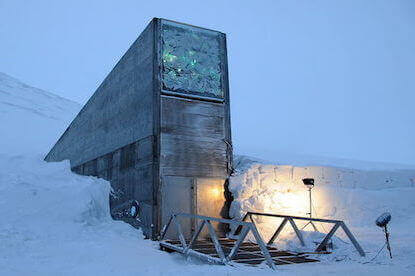
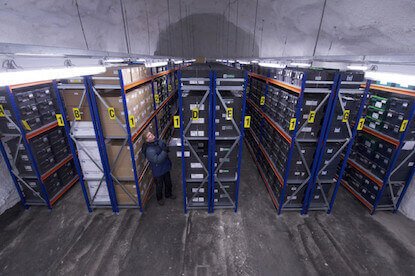
Seed banks collect, dry, and store seeds from thousands of varieties of crops: grains, vegetables, fruits, legumes, and wild relatives of domesticated plants. In an era of climate change, industrial agriculture, and rapidly shrinking biodiversity, these seed vaults are a crucial line of defense. If a crop variety is lost in the field due to war, weather, or disease, it may still survive in a seed bank, ready to be grown again. At the heart of this effort is the Svalbard Global Seed Vault, often called the “doomsday vault,” located on a remote Norwegian island in the Arctic.

From the Green Revolution to a New Seed Crisis
The term “Green Revolution” is often used to describe the wave of agricultural modernization that began in the 1960s. High-yield hybrid seeds, synthetic fertilizers, pesticides, and large-scale irrigation were promoted across the developing world. These technologies did, in many cases, dramatically increase food production. Fields that once produced modest harvests suddenly yielded two or three times as much grain, and many countries were able to reduce immediate hunger.
But this apparent miracle came with hidden costs. The new seeds often required heavy inputs—fertilizers, chemicals, and irrigation—drawing down water tables and putting pressure on ecosystems. Traditional seed varieties adapted to local climates and soils were abandoned in favor of a narrow set of “improved” crops. Farmers were encouraged, and sometimes pushed, into replacing diverse, resilient polycultures with monocultures of wheat, corn, or rice. Over time, this massive expansion in industrial agriculture depleted natural resources at an alarming rate.
Today, many regions that embraced the Green Revolution model are facing serious challenges: water shortages, soil degradation, and a dangerous loss of crop diversity. The developing world is now experiencing water and food shortages that leave billions food insecure and millions at risk of starvation. What was once portrayed as a permanent solution is now clearly only a temporary fix—and in some places, it has created new vulnerabilities.
GMO Seeds, Biotechnology, and Farmer Dependency
In an effort to address ongoing hunger and crop failure, organizations such as the World Food Programme and agencies within the United Nations have often partnered with major agribusiness companies to introduce genetically modified seeds—sometimes labeled under the friendlier term “biotechnology.” These seeds are engineered to express certain traits, such as herbicide tolerance or resistance to specific pests.
Critics argue that the term “biotechnology” can obscure the reality that many of these are genetically modified organisms (GMO), developed and patented by a small number of powerful companies. In some cases, these seeds are associated with traits that limit seed saving. For example, so-called “terminator gene” concepts have been discussed in the context of seeds engineered so that plants do not produce viable seed for the next generation. While not all GMO seeds on the market use terminator technologies, the concern remains: when farmers rely on patented seeds that must be purchased every year, they lose the ability to save their own seed and become more dependent on corporations for their future harvests.
Introducing corporate-controlled seeds into local agricultural systems can disrupt centuries-old practices of seed saving and sharing. Instead of collecting seeds from part of the harvest to plant the following year, farmers may be forced—legally or practically—to buy seeds each season. This shift can undermine traditional seed sovereignty and concentrate power in the hands of seed companies. Some activists and researchers warn that if genetically engineered traits were to spread unchecked into wild or indigenous seed stocks, it could alter or displace plant populations in ways that are difficult to reverse.
Whether or not the worst-case scenarios materialize, many people see a clear risk: when a handful of firms control the genetics of the world’s major food crops, they also gain enormous influence over the entire global agricultural system that so many people depend on. In this context, seed banks and seed vaults take on an added urgency—they represent a backup of the world’s pre-GMO, open-pollinated, and regionally adapted seeds.
The Svalbard Seed Vault: A Global Backup for Crop Diversity
It is no coincidence that governments, philanthropic foundations, and even some of the same agribusiness companies promoting GMOs have helped fund major seed banks. At the center of this network is the Svalbard Global Seed Vault, located on the remote Norwegian island of Spitsbergen, near the Arctic Circle. Often called the “doomsday seed vault,” Svalbard is designed as a fail-safe storage facility for duplicate samples of seeds held in gene banks around the world.
Officially, the Svalbard vault was created to protect and preserve the world’s seed crops in case of regional or global catastrophe. The site was chosen for its cold climate, geological stability, and relative political neutrality. Even if power were lost, the permafrost and thick rock are intended to keep the seeds frozen and viable for decades or centuries. Seed samples are shipped from national and regional seed banks, carefully cataloged, and stored in sealed packages inside vast underground chambers.
Seed banking is not new. Efforts to collect and protect crop seeds have been underway since at least the mid-20th century. Early projects often began with local seed collectors who recognized the importance of preserving landraces—traditional varieties that had adapted over generations to specific soils, climates, and cultures. Over time, these efforts expanded into national and international programs gathering seeds from the developing world, including Africa, Asia, and the Amazon, where plant diversity is both richest and most threatened.
Why Seed Banks Matter: Biodiversity, Climate Change, and Future Food Security
The loss of biological diversity is one of the greatest challenges facing the environment and sustainable development. Modern industrial agriculture tends to focus on a narrow set of uniform varieties, leaving countless traditional and wild relatives underused or forgotten. As fields become more genetically uniform, they can also become more vulnerable to disease, pests, and climate extremes.
Seed banks like the Svalbard vault act as a genetic library. Within their shelves are seeds that may carry traits for drought tolerance, disease resistance, or the ability to thrive in poor soils. As climate change accelerates and new plant diseases emerge, these traits could be essential for breeding new crop varieties that can withstand harsh conditions. Without this diversity, we risk losing the ability to adapt our food crops to a rapidly changing world.
In this sense, seed vaults are not just insurance against disaster; they are also a toolbox for future climate-resilient agriculture. Plant breeders, farmers, and researchers can draw upon the collections to revive old varieties, cross-breed new ones, and restore crops that have been lost in the field.
Seed Vaults as Protection Against Unintended Consequences
Beyond their official role in conserving biodiversity, many observers see seed vaults as a quiet acknowledgment of potential risks associated with modern agriculture and genetic engineering. If something were to go wrong—if a disease spread worldwide, if a major crop failed, or if genetically modified traits spread in ways that disrupted natural reproduction—seed banks could provide the raw material to rebuild.
Unofficially, facilities like the Svalbard Seed Vault are often described as a safeguard against unintended changes in plant reproduction that might result from introducing genetically modified seeds into complex ecosystems. While opinions differ on the likelihood and severity of these risks, the fact remains: governments, foundations, and corporations are investing heavily in preserving traditional seed varieties at the same time that new technologies are being deployed in the field.
For communities, farmers, and advocates of food sovereignty, the lesson is clear. Protecting and sharing seeds, supporting local seed banks, and maintaining living seed libraries on farms and in gardens are just as important as the high-tech vaults hidden in the Arctic. Together, these efforts help ensure that the world’s food-bearing plants—our vegetables, grains, herbs, and fruits—remain diverse, adaptable, and available for future generations.
In a world of increasing uncertainty, seed vaults and community seed banks form a vital safety net. They remind us that every harvest begins with a seed—and that protecting those seeds may be one of the most important food security strategies of all.